
Sawtooth beetles and merchant grain beetles are common pantry pests infesting stored grains, cereals, flour, and dried foods, creating contamination through droppings and body parts while reproducing rapidly in food storage areas.
Understanding the differences between these visually similar beetle species helps property owners identify infestations accurately and implement appropriate control strategies. Distinguishing between species informs management approaches addressing specific habitat preferences and food sources supporting each beetle population.
What are sawtooth beetles?
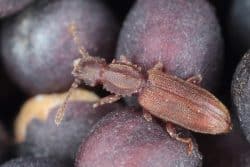
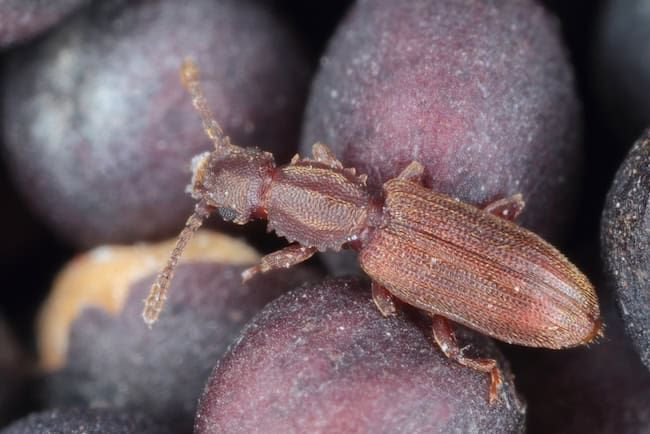
Sawtooth beetles (Oryzaephilus surinamensis) are small reddish-brown pantry beetles measuring approximately 1/8 inch in length, identifiable by distinctive sawtooth-shaped projections extending from sides of thorax (prothorax). These projections resemble saw teeth in profile, providing the common name. Sawtooth beetles originated in tropical regions but now occur worldwide infesting stored grains, cereals, flour, nuts, dried fruits, and various packaged foods. They’re among the most common pantry beetle pests in grain storage facilities and homes.
Sawtooth beetles establish populations rapidly in stored foods, with females laying dozens of eggs in food materials. Larvae develop entirely within food consuming grain and flour, creating contamination and reducing food value. Development from egg to adult requires approximately 3-4 weeks in warm conditions enabling multiple overlapping generations annually.
Adult beetles live several months, with females producing continuous eggs throughout lifespans. A single female can infest entire pantries through offspring production. Infested foods support population establishment lasting months without intervention. These persistent pests require comprehensive food management and elimination, preventing reinfestation.
What are merchant grain beetles?
Merchant grain beetles (Oryzaephilus mercator) are small reddish-brown beetles nearly identical to sawtooth beetles, measuring approximately 1/8 inch in length with subtle structural differences requiring magnification for confident identification. Like sawtooth beetles, merchant grain beetles possess sawtooth-shaped thorax projections. However, merchant grain beetles originated in temperate regions and show slight biological differences compared to sawtooth beetles. They infest similar food materials including grains, cereals, flour, and stored grain products.
Merchant grain beetles demonstrate stronger association with moldy or damaged grains compared to sawtooth beetles. They reproduce prolifically in stored grains with moisture content supporting fungal growth. Larvae develop within grain kernels creating contamination and viability reduction. Development from egg to adult requires 2-3 weeks in optimal conditions enabling rapid population growth.
Adult merchant grain beetles possess comparable lifespans to sawtooth beetles with similar reproductive output. Both species create identical food contamination and infestation problems. The distinction between species is primarily academic since control approaches address both species identically. However, identifying specific species informs understanding of infestation sources and prevention strategies.
What are the differences between sawtooth beetles and merchant grain beetles?
Sawtooth and merchant grain beetles appear nearly identical, requiring magnification and careful examination for definitive identification, with primary differences involving geographic origin, moisture preference, and subtle structural characteristics. Sawtooth beetles originate from tropical regions and tolerate lower moisture conditions compared to merchant grain beetles preferring higher moisture environments. Merchant grain beetles show stronger association with moldy grains while sawtooth beetles infest broader grain varieties.
Structurally, merchant grain beetles possess slightly different eye characteristics and body proportions compared to sawtooth beetles, though differences are subtle and require entomological expertise for confident identification. Both beetles produce identical contamination and infestation problems. Both reproduce rapidly and infest similar food materials.
From a pest management perspective, the species distinction is less important than recognizing pantry beetle infestation requiring remediation. Control strategies addressing one species effectively eliminate the other. Identifying which species is present provides only academic information rather than changing management approaches. Professional pest control assessment can confirm species identity when distinguishing between the two becomes necessary.
Geographic distribution differs slightly with sawtooth beetles more prevalent in warmer regions while merchant grain beetles occur more commonly in temperate climates. However, both species now occur worldwide through grain trade and shipping. Climate and seasonal variation influence population peaks but don’t prevent either species’ establishment in suitable food storage environments.
Are sawtooth beetles and merchant grain beetles dangerous?
Both sawtooth and merchant grain beetles pose contamination hazards through droppings, shed exoskeletons, and body parts accumulating in stored foods creating health risks requiring food disposal. Direct disease transmission from beetle contact is rare, though contamination creates consumption hazards. Infested foods containing beetle waste products should never be consumed regardless of infestation severity.
Consuming foods contaminated with beetle waste can cause gastrointestinal upset and allergic reactions in sensitive individuals. However, most contaminated foods are consumed unknowingly without serious illness—the primary concern is food waste and quality reduction rather than severe illness risk.
The greatest danger is allergen production from accumulated beetle debris and shed exoskeletons. Individuals with stored-product insect allergies can experience respiratory reactions and allergic responses to beetle-contaminated foods. Severe allergy cases require professional remediation eliminating contaminated materials.
Economic losses from infested foods represent the primary concern—contaminated foods require disposal resulting in substantial financial losses. Extensive pantry infestations affect multiple food items requiring wholesale pantry clearing and replacement. Prevention of infestations through proper food storage protects against economic loss exceeding actual health hazard risk.
How to avoid a sawtooth beetle or merchant grain beetle infestation
Preventing pantry beetle establishment requires food storage management and sanitation:
- Store foods properly: Keep grains, flour, cereals, and dried foods in sealed, airtight containers preventing beetle access to stored items.
- Practice food rotation: Use older foods first (FIFO), consuming older items before newer purchases preventing food spoilage supporting beetle populations.
- Inspect purchased goods: Examine packaged foods and grains before purchase checking for beetle evidence or damage indicating previous infestation.
- Clean storage areas: Remove accumulated crumbs, spilled foods, and organic debris from pantries and cabinets eliminating beetle food sources.
- Maintain cool temperatures: Store foods in cool areas reducing beetle reproduction rates and activity levels compared to warm environments.
- Control moisture: Keep storage areas dry reducing humidity and moisture-dependent conditions favoring merchant grain beetle establishment.
- Monitor regularly: Inspect stored foods periodically for beetle presence enabling early detection and intervention preventing population establishment.
How to know if you have a sawtooth beetle or merchant grain beetle infestation
Multiple indicators suggest pantry beetle infestation requiring remediation:
- Visible beetles in food: Finding small reddish-brown beetles in grains, flour, or cereal indicates active beetle populations in affected foods.
- Beetle larvae in foods: Discovering tiny white larvae in stored foods or pantry items indicates active reproduction and contamination.
- Webbing in grains: Fine webbing connecting grain kernels or flour particles indicates beetle activity and contamination requiring food disposal.
- Musty odors: Distinctive musty or unpleasant odors emanating from stored foods indicate bacterial growth from beetle contamination.
- Reduced food quality: Grains appearing discolored, clumpy, or deteriorated despite proper storage suggest beetle infestation and contamination.
- Beetle droppings: Fine powder or debris accumulating in storage containers or beneath affected foods indicates beetle waste and contamination.
- Damaged packaging: Holes or damage in grain and cereal packaging indicate beetle penetration and food access enabling infestation.
When to contact a professional
Discovering one pantry beetle doesn’t necessarily mean infestation. But repeated beetle sightings, visible larvae, contaminated foods, or persistent food damage suggest established populations requiring professional assessment. This is when to call a local pest expert.
DIY methods like sealed food storage and pantry cleaning capture visible beetles. But they often miss hidden infestations in wall voids, cracks, and storage cavities. They don’t address root causes enabling beetle population continuation. Cleaning and storage alone provide temporary relief without fixing underlying problems. This allows beetles to continue reproduction and reinfestation to occur.
A professional pest control service, like Aptive or Terminix, can help identify which beetle species is infesting your pantry—sawtooth or merchant grain beetles. They assess food storage conditions and moisture levels attracting beetle populations. They evaluate structural vulnerabilities including gaps and cracks enabling beetle access.
FAQs about sawtooth and merchant grain beetles
Here are some common questions homeowners have about sawtooth and merchant grain beetles.
A: Finding pantry beetles in bathrooms indicates they’ve traveled from food sources in kitchens or pantries seeking moisture and alternative harborage areas. Bathroom moisture attracts beetles seeking water sources. However, this suggests established infestations in food storage areas requiring thorough pantry inspection. Finding beetles distant from food sources indicates large populations with overflow activity spreading throughout homes requiring professional assessment.
A: Natural predators including parasitic wasps and predatory beetles control grain beetle populations in outdoor environments, though ineffective indoors where natural predators are absent. Freezing temperatures kill all beetle life stages when exposed to 0°F for extended periods. Diatomaceous earth applied to stored foods creates sharp particles killing beetles through contact damage. Professional products remain most reliable for consistent grain beetle elimination.