
It starts with one tiny fly darting past your face while you pour your morning coffee. Two days later, a whole cloud of them is hovering over the kitchen counter. Fruit flies multiply with astonishing speed—a minor annoyance can spiral into a full-blown invasion in under a week. The good news is that taking back your kitchen doesn’t require drastic measures, just a clear understanding of what drives them and how to cut off their lifelines.
What Are Fruit Flies?
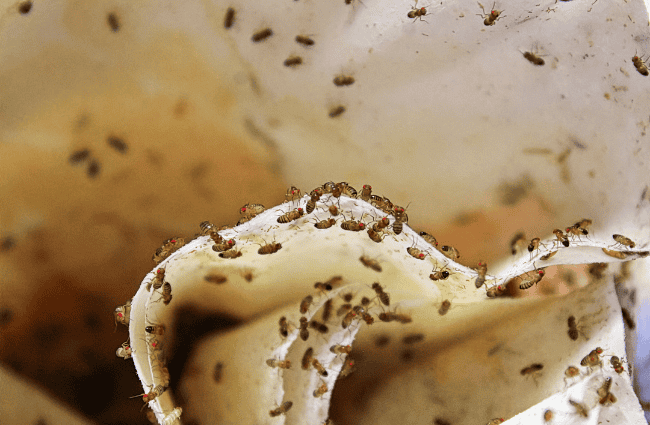
Fruit flies (Drosophila melanogaster) are tiny insects, usually about 1/8 inch long, with tan bodies and distinctive bright red eyes. There’s also a dark-eyed variant —called, predictably enough, the dark-eyed fruit fly.
What makes them such formidable kitchen invaders is their reproductive speed. A single female can lay up to 500 eggs directly on the surface of fermenting organic matter—an overripe banana, a damp kitchen sponge, the slimy film inside a garbage disposal, or a forgotten potato quietly decomposing in the back of a cabinet.
Those eggs hatch within a day into tiny larvae that feed on the yeast and fungi in decaying material. In about a week, they mature into reproducing adults. Left unchecked, the population grows exponentially, with each generation compounding the last.
How to Get Rid of Fruit Flies
If your kitchen is already swarming, the only real fix is breaking the breeding cycle. Traps and sprays might be satisfying, but they only catch adults that have likely already laid eggs. Here’s what actually works—and what doesn’t.
Eliminate the source
This is the only step that matters. Find what they’re feeding on and remove it. It might be a soft spot on a tomato, organic buildup coating the inside of a drain, or a trash can that hasn’t been emptied in a few days. No food source, no flies.
Clean again thoroughly
Tossing the rotting bananas and running some drain cleaner is a start, but it’s rarely enough on the first pass. Drains accumulate layers of organic film that a single cleaning won’t fully clear. Wipe down cabinet shelves where produce sat, scrub the drain a second time, and check under appliances for forgotten spills.
Isolate remaining produce
Move what you can into the refrigerator or freezer. Refrigeration halts larval development, and freezing kills eggs outright. Bagging individual items adds another layer of containment—if flies are still present, they’ll be trapped with the produce instead of spreading to new surfaces.
What doesn’t work (and why)
DIY vinegar traps catch adult flies, which feels productive—until you realize the ones you didn’t catch have already laid eggs. The larvae developing in your drain don’t care about the trap on the counter.
Bleach down the drain kills whatever it touches on the surface, but fruit fly larvae burrow into the organic buildup lining the pipe walls. The bleach flows right past them.
Natural deterrents like orange peels, cinnamon, or essential oils won’t repel fruit flies from an active food source. If the breeding material is still there, no scent is going to override that biological drive.
How to Prevent Fruit Flies
Prevention comes down to removing the conditions they need before they ever arrive.
Store ripe fruit in the refrigerator rather than leaving it on the counter—especially bananas, peaches, and tomatoes, which ferment quickly in summer heat. Empty kitchen trash cans daily during warm months, and keep lids sealed between uses. Clean drains weekly with a stiff brush or bio-enzymatic cleaner to prevent the organic film that larvae feed on from building up.
Don’t overlook secondary sources. Recycling bins with residual juice or beer, compost containers without tight lids, and damp mops or sponges left sitting overnight are all viable breeding sites. Fix torn window screens and seal gaps around doors—fruit flies aren’t strong fliers, but they don’t need much of an opening.
When to Call a Professional
Most fruit fly problems resolve once you find and eliminate the food source. But if you’ve scrubbed the kitchen top to bottom, refrigerated your produce, emptied every trash can, and you’re still seeing clouds of flies after two weeks—something hidden is sustaining them.
Persistent infestations often trace back to breeding sites homeowners can’t easily access: deep inside floor drains, under cracked tiles, behind dishwashers, or inside wall cavities with a slow moisture leak. Our pest control experts have the diagnostic tools and bio-enzymatic treatments to isolate and eliminate these deep-set sources that surface-level cleaning can’t reach.
Fruit Fly Frequently Asked Questions (FAQs)
Here are some common questions from homeowners about fruit flies.
A: No. Fruit flies don’t have the piercing mouthparts needed to break skin. They feed exclusively on liquids and soft, decaying organic matter.
A: An individual adult lives about 40 to 50 days at room temperature. But because they breed continuously, an infestation will persist indefinitely until you remove their food source. The lifespan of a single fly is almost irrelevant—it’s the cycle that matters.
A: Not exactly. “Gnat” isn’t an officially recognized common name—according to the Entomological Society of America, the insects people call gnats are usually phorid flies, moth flies, or fungus gnats, each with different habits and food sources. Some midges and other small flies also get lumped in. Correct identification matters because it changes where you look for the source.
A: Usually, yes. Fruit flies aren’t strong fliers, so where you see them is likely very close to where the larvae are developing. But they can also breed in outdoor sources—the gunk at the bottom of recycling bins, compost piles, or garden debris. If you’ve cleaned everything indoors and they’re still showing up, check outside and repair any broken screens or door gaps while you’re at it.