

Discovering evidence of a rodent in your home triggers a predictable sequence: panic, disgust, and a trip to the hardware store. Grab a pack of snap traps, set them along a basement wall, and hope for the best.
A few days later, the bait is gone, the traps are unsprung, and fresh droppings have appeared on the pantry shelf.
The most common reason DIY rodent control fails is deceptively simple: treating a mouse like a small rat, or a rat like an oversized mouse. In urban pest biology, house mice and rats—whether roof rats or Norway rats—are radically different animals with distinct behaviors, dietary preferences, travel patterns, and levels of wariness. If you want to eliminate a rodent problem, step one isn’t setting a trap. Step one is figuring out exactly what you’re dealing with, because your entire strategy depends on it.
Behavioral Differences: Curiosity vs. Neophobia
The single biggest factor shaping your control strategy is the mental wiring of the animal you’re up against.
Mice Are Inquisitive
House mice are notably more curious than rats. When a new object appears in their territory—a snap trap, a bait station, a monitoring device—they’ll investigate it relatively quickly. They sample unfamiliar food sources without much hesitation, which makes them comparatively easy to catch with freshly placed traps positioned in active travel corridors.
Rats Are Neophobic
Rats operate on the opposite end of the spectrum. They exhibit neophobia—an intense, survival-driven fear of anything new or unfamiliar in their environment. Place a brand-new snap trap along a rat’s established travel path and it won’t curiously inspect it. It will actively avoid it, reroute around it, or abandon that section of its territory for days.
This distinction has a direct strategic consequence. To trap a rat successfully, you have to pre-bait unset traps for several days until the animal accepts the device as a safe, permanent feature of its environment. Only then do you arm the trigger. Skip this step, and you’ll watch bait disappear from sprung traps night after night.
Identification: Droppings, Physical Features, and Gnaw Marks
Rodents are nocturnal and skilled at staying hidden. You’ll almost always find their evidence before you see the animal itself.
Droppings
Droppings are the fastest way to identify which species you’re dealing with, and each leaves a distinct signature.
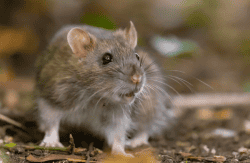
Mouse droppings are small, thin, and pointed at both ends—roughly 1/8 to 1/4 inch long, about the size of an uncooked grain of rice. A single mouse produces 40 to 100 droppings per day, scattered liberally across its travel routes.
Norway rat droppings are significantly larger—capsule-shaped pellets with blunt, rounded ends, measuring 1/2 to 3/4 inch long. Think olive pit or watermelon seed.
Roof rat droppings are slightly smaller than Norway rat droppings, around 1/2 inch, with pointed ends and a distinctive crescent curve.
Physical Features
If you catch a glimpse of the animal, don’t rely on size alone—a young rat is easily mistaken for an adult mouse. These features are more reliable:
| Feature | Adult House Mouse | Young Norway Rat |
| Head & Snout | Small, triangular head with a pointed snout | Large, blocky head with a blunt, heavy snout |
| Ears & Eyes | Large, prominent ears; small eyes relative to head | Small, hairy ears; small eyes relative to head size |
| Feet | Small, delicate, proportionate to body | Disproportionately large (“clown feet”) |
| Tail | Thin, lightly haired, equal to body length | Thick, heavy, hairless and scaly, shorter than head + body |
The feet are often the giveaway. If the animal looks mouse-sized but has oversized paws, you’re looking at a juvenile rat.
Gnaw Marks
Both species chew constantly to keep their continuously growing incisors worn down, but the scale of damage differs significantly. Mice leave small, clean gnaw marks roughly the width of a pencil lead—visible on cardboard boxes, plastic bags, and baseboards. Rats possess powerful jaw muscles capable of chewing through wood, soft metals, wall studs, and heavy plastic, leaving broad, rough-edged gouges. A hole chewed by a rat looks like something took a bite out of the material.
Travel and Nesting: Where to Look and Where to Trap
Understanding how each species navigates physical space determines where your control measures need to go.
House Mice
Mice are nimble climbers that scale textured walls, wires, and pipes with ease. But their territory is surprisingly compact—with food and shelter nearby, a mouse rarely travels more than 10 to 30 feet from its nest. If you’re finding droppings in the pantry, the nest is almost certainly in that room or an adjacent wall void.
Norway Rats
Norway rats are heavy, ground-dwelling burrowers. They prefer to nest outdoors in soil burrows along foundation walls, under concrete slabs, or beneath dense woodpiles, traveling indoors to feed. Their home range is much larger than a mouse’s—often covering 100 to 300 feet along established pathways every night. Look for dark, greasy rub marks along baseboards and foundation walls, which indicate high-traffic routes.
Roof Rats
Roof rats are agile climbers that favor high-elevation nesting. They travel along overhead power lines, fence tops, and tree limbs to enter homes through attic vents, soffits, and roofline gaps. If you’re hearing activity in the ceiling but finding no ground-level evidence, roof rats are the likely culprit.
Entry Points: Size Matters
Structural exclusion is the most important long-term investment in rodent control, but the specifications depend entirely on the species.
A house mouse can squeeze through an opening as small as 1/4 inch—roughly the width of a pencil. If a pencil fits into a foundation crack or gap beneath a door, a mouse can walk through it. A rat requires a larger opening, at least 1/2 to 3/4 inch—about the diameter of a quarter. However, if a rat detects warm air leaking through a smaller gap, it will gnaw the opening wider until its skull fits through. The hole you sealed last month may not stay sealed if the material isn’t rodent-proof.
Use copper mesh, hardware cloth, or steel wool backed with caulk for small gaps. Larger openings around pipes, vents, and garage door thresholds need metal flashing or heavy-gauge wire mesh.
Trap and Bait Strategy by Species
Using the same trap setup for both species is a recipe for failure. The placement, density, and timing all change based on what you’re targeting.
For mice, deploy many traps spaced closely together—every three to five feet along baseboards, directly inside pantries, behind appliances, and inside drawers where droppings are concentrated. Bait with a small dab of peanut butter or a piece of cotton (nesting material works surprisingly well). Mice explore new objects quickly, so freshly placed traps can produce catches within hours.
For rats, deploy heavy-duty rat snap traps along established rub-mark runways near ground level or attic beams. Do not set the triggers for the first three to five days—bait the unset traps with peanut butter, bacon grease, or dried fruit and let the rats feed freely. Once bait is being taken consistently, arm all triggers simultaneously. This overcomes neophobia and catches multiple animals before the colony can react.
Common Mistakes That Undermine Control
Wrong trap size: A mouse snap trap used on a rat results in stolen bait or a wounded, aggressive animal that escapes and becomes trap-shy. A heavy rat trap used on mice fails because the animal isn’t heavy enough to trigger the tension plate.
Bare-hand handling: Rodents have an acute sense of smell. Handling traps without gloves deposits human skin oils that warn cautious animals—especially rats—to stay away. Always wear clean gloves when baiting and setting.
Center-of-room placement: Rodents are thigmotactic—they navigate by keeping their whiskers and bodies in contact with vertical surfaces. A trap placed in the middle of an open floor will be completely ignored. Set traps perpendicular to walls with the trigger plate facing the baseboard.
Why Small Problems Explode Quickly
Both species have staggering reproductive capacity. A single pair of mice under ideal indoor conditions can produce dozens of offspring in one season. Female mice enter postpartum estrus—meaning they can mate again within 48 hours of giving birth—so population growth is exponential. Rats reproduce more slowly but produce larger, hardier offspring that mature quickly. A minor autumn sighting can become a full-scale infestation by midwinter if the population isn’t addressed early.
When to Call a Professional
A single mouse in a snap trap might close the book on a minor, isolated intrusion. But certain signs point to a problem that’s outgrown consumer-grade tools.
Daytime sightings: This means population density is high enough that weaker individuals are being forced out of prime harborage during hours they’d normally hide. That’s not one rodent—that’s an overcrowded colony.
Widespread rub marks: Dark, greasy trails running along foundation walls, ceiling joists, or pipe chases—indicate high-volume, long-term traffic across multiple pathways.
Sounds in multiple rooms: Persistent scratching or chewing inside walls across different floors or rooms signals multiple established nesting sites, not a single point of entry.
Traps failing consistently: If you’re finding fresh droppings but traps remain untouched after a week of proper placement, you’re likely dealing with a bait-shy or trap-resistant population that requires professional tracking and commercial-grade equipment.
A licensed pest management professional can conduct a full structural audit, deploy tamper-resistant bait stations with appropriate active ingredients, execute high-elevation attic exclusions for roof rats, and eliminate the infestation at its source—not just the foragers you happen to see.
Pest Control Experts connect homeowners with trusted local professionals—including Terminix and Aptive—who specialize in species-specific rodent control, from structural exclusion to targeted trapping and baiting programs. Contact Pest Control Experts for a free quote and schedule your home inspection today.