
Termites tend to steal the spotlight when it comes to wood-destroying pests, but carpenter ants quietly cause millions of dollars in structural damage every year. The difference is in the method: termites digest wood fiber, consuming it from the inside out.
Carpenter ants don’t eat wood at all—they carve it, hollowing out smooth galleries to house their expanding colonies. Left unmanaged, a mature nest can silently compromise wall studs, window headers, and roof framing for years before anyone notices.
What makes carpenter ants especially frustrating is that they exploit problems your home already has. They don’t attack healthy, dry timber—they target wood that’s been softened by moisture damage, then expand from there. Recognizing the early signs, understanding why moisture is the real vulnerability, and knowing when DIY falls short can save you from a repair bill that dwarfs the cost of treatment.
What Do Carpenter Ants Look Like?
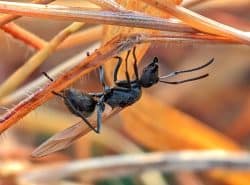
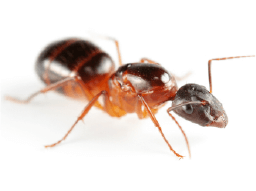
Carpenter ants are among North America’s largest ant species. Workers range from about 1/4 inch (minor workers) to over 1/2 inch (major workers and queens)—large enough that most homeowners do a double-take the first time they see one on a kitchen counter.
Most are solid dark black, though some species feature reddish or dual-toned bodies. Their defining physical traits are a smooth, evenly rounded thoracic profile and a single narrow waist node (petiole) between the thorax and abdomen.
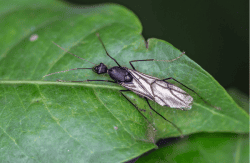
Size alone sets them apart from most household ants, but the real identification challenge comes during swarming season—when winged carpenter ant reproductives are easily confused with termite swarmers.
Carpenter Ants vs. Termites
Telling the two apart matters because the control strategies are completely different. Three visual differences settle it quickly.
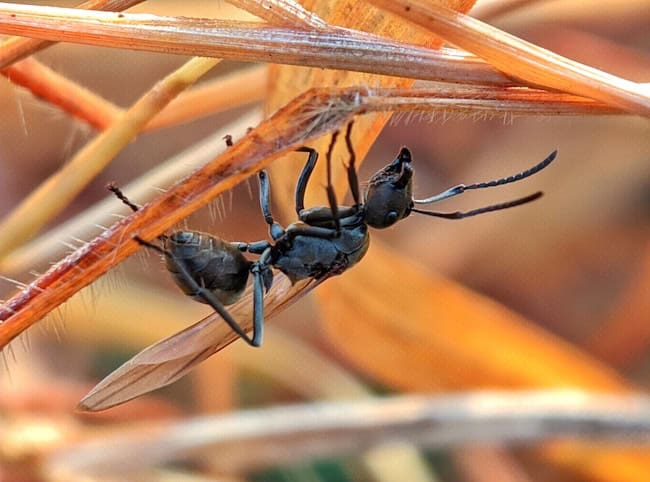
Waist shape is the most reliable field marker. Carpenter ants have a narrow, distinctly pinched waist—similar to a wasp. Termite swarmers have a broad, uniform body with no visible waist constriction.
Antennae differ in structure. Carpenter ant antennae are sharply elbowed, bending at a clear angle partway along their length. Termite antennae are straight, resembling a string of tiny beads with no bend.
Wings tell the final story. Carpenter ant swarmers have two pairs of translucent wings, with the front pair noticeably longer than the rear. Termite swarmers have four wings of identical size and shape—and they shed them almost immediately after landing, which is why piles of discarded wings near windowsills are a classic termite sign.
Reading the Evidence: Frass and Galleries
Because carpenter ants work inside structural wood, the damage is rarely visible until it’s advanced. What you will find—if you know where to look—is the waste they push out as they excavate.
As workers carve galleries through studs, joists, or logs, they eject debris through tiny slits in the wood surface. This material is called frass—coarse, fibrous wood shavings that resemble pencil-sharpener debris, often mixed with fragments of dead insects and ant body parts. Finding small piles of frass beneath baseboards, along window trim, or on attic joists is one of the most reliable early indicators of an active colony.
The galleries themselves are distinctive. Unlike termite damage, which is rough, mud-packed, and follows the soft grain of the wood, carpenter ant galleries are clean, smooth, and almost polished-looking—as if someone ran fine sandpaper through the interior. They cut across the wood grain to form interconnected chambers for brood rearing, and the wood they remove gets pushed out as frass rather than consumed.
If you break open a piece of suspected carpenter ant damage and the tunnels look smooth and debris-free inside, you’re looking at their work—not termites.
The Moisture Connection
This is the single most important thing to understand about carpenter ants: they don’t randomly attack wood. Initial nests almost always establish in timber that has already been compromised by moisture—water leaks, condensation, poor drainage, or chronic humidity.
Moisture-damaged wood is softer, easier to excavate, and provides the high humidity that eggs and young larvae require to develop. The parent colony needs these conditions to survive. It’s only after the colony matures—typically three to five years in—that workers begin expanding into drier structural wood, branching out from the original damp site into sound timber throughout the house.
Common interior hotspots include wall voids beneath leaky windows, wood framing around clogged or overflowing gutters, bathroom subflooring with chronic moisture exposure, and poorly ventilated crawl spaces where humidity stays elevated year-round. The pattern is consistent: find the moisture, and you’ll find the nest. Fix the moisture, and you remove the condition that made your home a target in the first place.
Colony Structure: Parent Nests vs. Satellite Nests
Understanding how carpenter ant colonies organize themselves explains why perimeter spraying doesn’t work—and why infestations persist even after homeowners think they’ve addressed the problem.
The Parent Colony
The parent colony is the reproductive center. It houses the primary queen, eggs, and young larvae, and it requires consistently high moisture to sustain brood development. Parent colonies are almost always located outdoors—in decaying tree stumps, rotting landscape timbers, old woodpiles, or fallen logs. This is where the colony originates, and where the queen continues producing eggs.
Satellite Nests
After three to five years of growth, the parent colony starts establishing satellite nests. These contain mature larvae, pupae, and workers, but no queen and no eggs. Because they don’t need to support early brood development, satellite nests require less moisture—which means they can establish inside your home’s heated, relatively dry building envelope. Wall voids, hollow-core doors, foam insulation panels, and attic framing are all common satellite locations.
This is where most homeowners encounter the problem. The ants you see foraging in the kitchen at night are likely traveling from a satellite nest inside the structure. But killing those workers—or even destroying the satellite nest—won’t end the infestation if the outdoor parent colony is still producing new workers and sending them back in. Permanent elimination requires locating and treating both the parent colony and every satellite.
Prevention Around the Home
Proactive environmental management dramatically lowers your risk—and most of it comes down to eliminating the moisture and access points carpenter ants depend on.
Trim vegetation so tree branches and shrubs stay at least 12 to 18 inches from siding and rooflines. Branches touching the structure are direct highways—carpenter ants are primarily nocturnal foragers, and they follow these pathways from outdoor nesting sites straight into your walls.
Manage firewood carefully. Never stack firewood against foundation walls or inside a garage. Woodpiles are prime carpenter ant habitat, and proximity to the structure turns a natural nesting site into a staging area. Store wood on elevated metal racks at least 20 feet from the house.
Fix drainage issues before they become carpenter ant problems. Clean gutters regularly, repair leaking spigots and hose bibbs, and make sure downspouts discharge water at least five feet from the foundation. Any wood that stays damp consistently is a candidate for colonization.
Seal entry points around window frames, door trim, and utility penetrations with silicone caulk. Pay particular attention to where pipes and wires enter the structure—these gaps are common travel routes between outdoor parent colonies and indoor satellites.
Remove dead wood from the property. Old tree stumps, fallen branches, and rotting landscape timbers left near the house are exactly the kind of decaying wood parent colonies establish in. Removing them eliminates nesting habitat before colonies have a chance to mature and send satellites indoors.
Why Spraying Doesn’t Work
Grabbing an aerosol can and dousing the baseboards when you spot a large black ant is one of the most counterproductive things you can do. Fast-acting repellent sprays kill only the small percentage of the colony that’s out foraging—typically around 2% of the total population. The queen, the brood, and the rest of the workers remain untouched inside the nest.
Worse, repellent chemicals alert the colony to a threat. Workers that detect the residue will abandon the affected area and relocate satellite nests deeper into your walls—a process called budding. You haven’t reduced the colony. You’ve scattered it.
The effective alternative is slow-acting, non-repellent bait—granular or gel formulations that foragers carry back into wall voids and share with nestmates through trophallaxis. The toxicant circulates through the colony over days, reaching workers, larvae, and eventually the queen. It takes patience, but it works with ant biology instead of against it.
When to Call a Professional
Baiting can manage occasional foragers, but certain signs indicate a problem that’s moved beyond what consumer products can resolve.
Winter sightings are a red flag. Carpenter ants spotted indoors during cold months confirm an established satellite nest inside your home’s heated envelope—outdoor ants aren’t active in winter, so these are living in the structure year-round.
Fresh frass accumulations beneath walls, baseboards, or attic joists point to active excavation happening right now. If frass keeps reappearing after you clean it up, the colony is growing, not declining.
Winged swarmers indoors during spring signal a mature colony—typically three to five years old—established inside or immediately adjacent to the structure. By the time a colony produces swarmers, it’s been doing damage for years.
Audible rustling inside walls is the sound of a large, active nest. A colony big enough to hear is a colony that’s been excavating structural wood for a long time.
A licensed pest management professional brings tools that consumer products can’t match: non-repellent transfer insecticides that spread through the colony via contact, wall-void injection equipment that delivers product directly into satellite nests, and thermal imaging to locate hidden colonies without tearing open drywall. If the signs point to an established infestation, professional intervention targets both the parent colony and its satellites—the only way to end the cycle permanently.
Pest Control Experts connect homeowners with trusted local professionals, like Terminix, who specialize in carpenter ant diagnostics and structural pest control. Contact Pest Control Experts for a free quote and schedule your home inspection today.